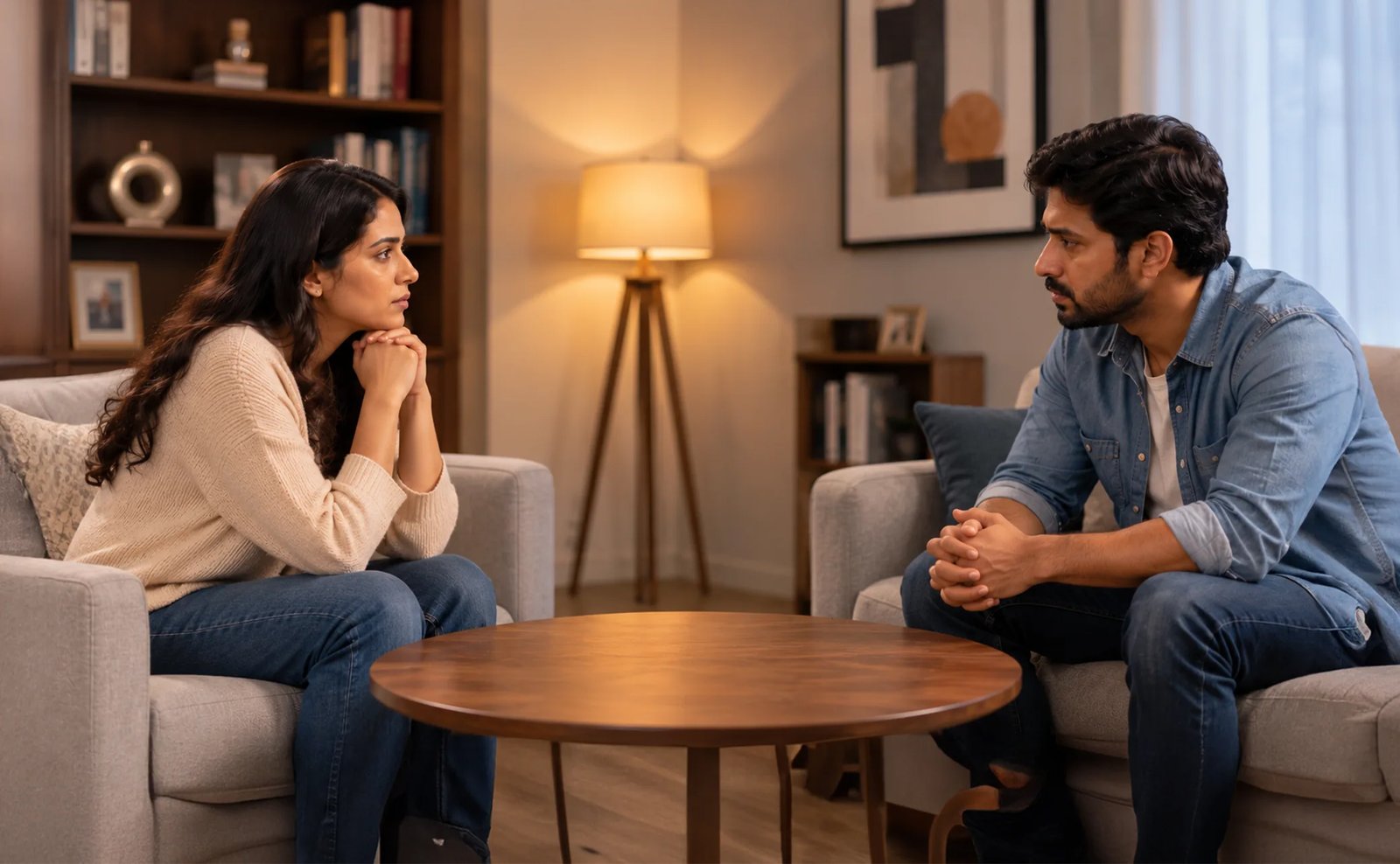
Every couple fights. Every couple goes through a rough patch where conversations feel more like negotiations than connection. That’s normal. What isn’t normal is when distance becomes the default setting, and neither partner knows how to close it. That’s usually the point where relationship counselling stops being “something other people need” and starts being the thing that could actually save what you have.
Most Indian couples wait far too long before reaching out for help. There’s still a quiet stigma around it, a sense that asking for support means the relationship has failed. It hasn’t. It usually just means two people who care have run out of tools to fix things alone.
People Also Ask
How long does relationship counselling usually take?
At Talk n Share, individual sessions run 60 minutes, and couples sessions 90 minutes. Most couples notice better communication within a few sessions, though full resolution depends on the pattern’s length.
How much does Couple counseling cost?
At Talk n Share, individual sessions cost ₹1,800 for 60 minutes, and couples sessions cost ₹2,800 for 90 minutes. Prices vary elsewhere in Delhi-NCR, so confirm with your chosen clinic.
Here are ten signs worth paying attention to before the gap widens further.
1. You’ve stopped fighting altogether
This one surprises people. Constant arguing is a red flag, but so is its opposite. When couples go quiet and stop bringing up what’s bothering them, it’s often not peace; it’s exhaustion. Silence like that builds resentment faster than any argument.
2. Every conversation turns into a blame game
If most conversations end with “you always” or “you never,” you’re not really talking; you’re keeping score. This is one of the clearest signs a couple has lost the ability to problem-solve together and could benefit from structured couple counseling to rebuild that skill.
3. You’re more comfortable talking to friends than your partner
When your partner is the last person you’d tell about a bad day, something has shifted. A relationship works when the other person is your first call, not your last resort.
4. Intimacy has quietly disappeared
Not just physical intimacy, emotional intimacy too. If sharing your day, your worries, your small wins feels like a chore, or doesn’t happen at all, that gap tends to widen on its own.
5. Trust has been broken and hasn’t healed
Whether it’s infidelity, a lie, or a broken promise, some wounds don’t close with time alone. This is exactly where relationship therapy gives couples a structured, guided space to process what happened, instead of circling it forever.
6. You’re staying together only for the kids or family pressure
If the only glue holding things together is obligation, both partners usually know it, even if nobody says it aloud. Couples therapy can help figure out whether the relationship is salvageable or whether both people need a more honest conversation about what comes next.
7. One or both of you feel constantly criticised
Feeling like you can’t do anything right in your partner’s eyes is corrosive. Over time it chips away at self-worth and turns the relationship into something to survive rather than enjoy.
8. Small issues keep turning into big fights
If a disagreement about whose turn it is to call the electrician ends in a three-hour fight about the whole marriage, that’s not really about the electrician. It’s a sign the underlying issues were never resolved.
9. You’ve considered separation more than once
Thinking about it occasionally during a bad week is human. Thinking about it seriously and repeatedly is different. Many couples in Delhi and across India turn to marriage counseling at exactly this stage, once the thought has crossed their mind too many times to ignore.
10. You want to fix things, but don’t know how anymore
This might be the most common sign of all. Both partners still care, still want it to work, but the usual conversations keep going in circles. That’s not a sign the relationship is broken beyond repair. It’s usually a sign you need a third person in the room who isn’t emotionally tangled up in the outcome.
Not sure if relationship counselling is the right step?
If these signs feel familiar, connect with Dr. Sangeeta Gupta at Talk n Share for confidential relationship counselling. Online and in-person sessions available.
Book AppointmentWhat happens if you keep ignoring these signs?
Nothing dramatic happens at first. That’s exactly what makes it dangerous. Nobody wakes up one morning and decides to end things over a single bad fight. It’s slower than that; one unresolved argument gets buried under the next, until one partner has quietly checked out long before the other notices anything’s wrong.
According to Dr. Sangeeta Gupta, Founder of Talk n Share, “Most couples who eventually walk into relationship counselling have been sitting with the same unresolved issue for a year, sometimes longer. Time doesn’t shrink the problem. It just changes who’s doing the talking, from two people trying to fix something to two people defending themselves.
The couples who come in early, while there’s still enough goodwill left in the room to work with, tend to have a much easier time of it than the ones who wait until the resentment has hardened.
Final Takeaway
None of these ten signs, on their own, mean your relationship is over. What they mean is that two people who still care are stuck, and stuck isn’t the same as broken. The couples who come out stronger aren’t the ones who never struggled; they’re the ones who stopped waiting for things to fix themselves and asked for help while there was still something worth fighting for.
If you’ve been thinking about taking this step, don’t hesitate; connect with our expert, Dr. Sangeeta Gupta, at Talk n Share today.
Frequently Asked Questions
Q1. Is relationship counselling only for couples on the verge of breaking up?
No. Many couples come in during smaller rough patches, not just crises. Addressing issues early, before they harden into bigger patterns, usually makes the process shorter and the outcomes stronger.
Q2. Can one partner attend counselling if the other refuses to come?
Yes, individual sessions still help. A counsellor can help you understand your part of the pattern, and often that shift alone opens the door for your partner to join later.
Q3. What actually happens in the first relationship counselling session?
The first session is mostly about understanding your story, not solving everything at once. The counsellor listens to both partners, maps out the core issues, and sets a rough direction for the sessions ahead.
Q4. Is online couple counseling as effective as in-person sessions?
Yes, online sessions offer the same structure and privacy, with the added convenience of skipping travel, which matters for busy working couples across Delhi-NCR.